Showing posts with label Off my shelf. Show all posts

Saturday, 15 January 2022

QuickLit January 2022: Reading year review

 Linking up with Modern Mrs Darcy once more for QuickLit reviews. Time to look back on my reading year. Last January, I declared that my goal was actually to read fewer books, but more mindfully. I did end up down on the 2020 count, but not really for the intended reason. I just ran out of steam by October - Covid fatigue, I guess. I even stopped remembering to note down which books I'd read, but luckily they were almost all on Kindle, so I could figure it out. So, as far as I know, my stats are:

Total: 41 books (I was averaging a little over 50 the past few years)

Print books: 9

E-books: 31 (Due to Covd restrictions, I only had one trip to the UK to stock up on print English language books.)

Audiobooks: 1 (But it was the enormous Clan of the Cave Bear. I also listened to a lot of podcasts.)

Fiction: 36

Non-fiction: 5 (I prefer to read non-fiction in print form so that I can flip back and forth, so this one is obvious.)


Here are my favourites of 2021:

Taylor Jenkins Read - Daisy Jones and the Six

My parents grew up in the 60s, so our house was full of  sixties music, which is why I'm a Stones and Kinks fan. This book nailed the 60s/70s rock scene - it felt like I was reading a non-fiction memoir. An investigative journalist tracks down members of the iconic band Daisy Jones and the Six to find out why they split up at the height of their meteroic rise to fame. Absolutely read if you're a fan of this musical era!
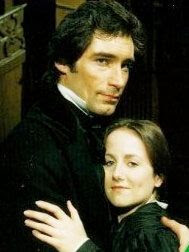

Timothy Dalton is THE Mr Rochester, and I'll take off my corset and fight anyone who disagrees ;)

Charlotte Bronte - Jane Eyre

I read through all of Charlotte Bronte's novels this year. It began with Jane Eyre - I always name it as my all-time favourite book, but I hadn't read it for a while, and I was afraid to find out if it had lost its charm. Reader, fear not. Fierce, independent Jane, who holds fast to her integrity whatever the world throws at her, is a timeless heroine. And I still get a deep thrill at the words, 'Reader, I married him.'

Kazuo Ishiguro - The Remains of the Day

I totally hated the ending of The Buried Giant, and there's no way I'm going to frighten myself with Ishiguro's dystopian novels, so it took me a while to try this one. In the 1950s, a butler takes a road trip to meet a former housekeeper, and reflects on his life of service to a high-minded but ultimately misguided lord. A beautifully written, bittersweet reflection on lost love and lost causes, but with a little hope at the end.
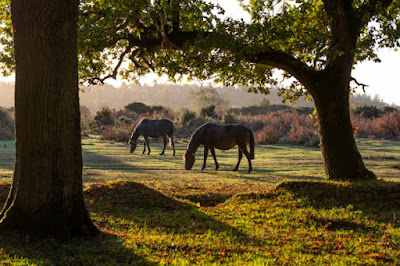

The iconic New Forest ponies

Edward Rutherford - The Forest

Rutherford seems to have carved out a niche penning huge tomes that cover centuries of history. I'd read the more well-known Sarum, but I think I enjoyed this even more. The novel tells the stories of the families (and trees and animals) who inhabited the New Forest over a thousand years of history (yes, in Britain, a forest gets to be called new when it's only a thousand years old). This, and Sarum, is really a series of interlinked novellas, so they're a good choice if you love historical fiction and/or want to tackle a large book for a reading challenge.

Molly Martin - The Art of Repair

I read this in May, but still keep turning to it. This slender volume is part clothing repair manual, part paean to the art of caring for our belongings. Her few methods are simple (well, OK, I don't feel up to tackling Swiss darning yet), but her love for mending is infectious. And slowly Sashiko stitching a patch on my son's trousers, when I could replace them for a few euros, feels like a subversive act of rebellion in our throwaway society.



Phillipa Langley and Michael Jones - The King's Grave

As a teenager, I was a devoted Ricardian, reading everything about Richard III I could get my hands on, fiction and non-fiction. I even wrote 'Richard III is innocent' on the front of my school history notebook! The King's Grave is Langley's account of the excavation of the Leiceistershire abbey that led to the discovery of Richard III's grave in 2012, interspersed with Jones's revisionist biography of this controversial king, England's last monarch to die in battle. I have a more moderate view of Richard now, though I'm still inclined to think he did not order the murder of the Princes in the Tower. And for 2022, I'm exicted to put Nicola Cormick's new novel The Last Daughter (US: The Last Daughter of York) on my reading list, a historical fantasy take on the fate of the younger prince.

I think 2022 is going to be a slower reading year, as my main goals are more Slovene classes (got to get fluent in the language since I live here) and finishing the sequel to my novel A Dorset Summer. But my six-year old is now into longer chapter books, so I'll have more interesting kiddie reading. We're currently up to The Voyage of the Dawn Treader in the Narnia series. How was your 2021? Do you have 2022 reading goals, or, like many of us, have you ditched your usual plans? If you have a review, I'd love to link to it!

A roundup of 2022 Quicklit reviews:

Katie @ The Cozy Burrow

Shannon @ Shannon Enjoys Life!

Elena @ A Beautiful Hope

Susan @ In the Storm

Thursday, 15 July 2021

QuickLit July 2020

 Linking up with Modern Mrs Darcy as usual. In retrospect, it is quite clear why I ended this past month with no palpable desire about what to read next - I must have drained all my emotional reading resources with these two titles.

Credit: http://www.impawards.com/1993/remains_of_the_day.html

Kazuo Ishiguro - The Remains of the Day

I gave Ishiguro another go, even though I hated the ending of The Buried Giant. In this Booker Prize novel set in the 1950s, an aging butler takes a road trip to visit a former housekeeper, and along the way, reminisces about a lifetime devoted to the service of Lord Darlington. Beautiful, restrained prose makes this story of lost causes and lost love all the more bittersweet. And, thank goodness, a glimmer of positivity at the end. I've never seen the film adaptation, but reading this, I can imagine that Emma Thompson was perfect as the housekeeper.


Charlotte Brontë - Villette

Most of the month was taken up with re-reading Villette. I'd only read it once, decades ago, and pretty much just recalled the end. Wow. Its effect crept up on me gradually, but by the end I wanted to throw around clichés such as tour de force and masterpiece of psychological drama. Cast on her own devices, Lucy Snowe follows a whim and travels to Villette (a fictional Belgian town), where she finds work as a nanny and then English teacher at Madame Beck's school. Lucy occupies the invisible position of a working middle class woman. 'I am a cypher,' she says, and the tension in the story comes from the way she is labelled by others (passive, uncontroversial) and the passionate, opinionated person she is within. She is so used to hiding, that she even conceals facts from the readers at times, sometimes drawing us in, sometimes pushing us away. I was pretty exhausted by the time I finished it. Jane Eyre will always have my heart, but Villette has my respect.

And has anyone else read and re-read that penultimate paragraph, trying to will yourself into discovering a different ending?

I'll pad out this post with a favourite I bought for my son recently:


Linda Skeer - Dinosaur Lady: The Daring Discoveries of Mary Anning, the First Paleontologist

I spent much of my childhood on the Jurassic coast, so I've been fascinated by Mary Anning for decades. This is a colourful introduction to the fossil-hunting Dorset girl who relied on her own skills, studies and deductions to discover new species, and is arguably one of the founders of paleontology, even though, as a lower-class woman, she was often slighted by the men who came to rely on her expertise.

Looking forward to reading your reviews! Have you read a book that just exhausted you? Any recommendations to bounce back?


Tuesday, 16 March 2021

I am Jane: On Re-reading Jane Eyre


'Reader, I married him.' 

Four words in English literature that never cease to send a thrill up my spine (and threaten a tear). I discovered Jane Eyre around the age of fourteen: I was instantly captured. Those were simpler days, pre-YA literature, at my all-girls' grammar school. Our surging adolescent emotions found expression in the Brontës and Georgette Heyer, while a few more daring readers devoured Mills and Boon novels. I fell in love with Mr Rochester, of course, and would have been off to France with him in a trice. When the BBC fortuitously put out a Sunday tea-time serial of the novel, my best friend and I watched it religiously. After the episode when Jane leaves Mr Rochester, we phoned each other and sobbed down the line, much, I suspect, to the amusement of our parents, who got to listen in because of course there was only the one family telephone at that time. (Timothy Dalton is, by the way, Mr Rochester. No other.)

Fast forward several decades. I had not re-read Jane Eyre for maybe fifteen to twenty years, yet I still cite it as my favourite novel. This began to nag at me – I should pick it up again. But fear held me back. What if, in middle age, it disappointed? Could I bear to lose those feelings? On the other hand, after a year of pandemic, what was left to crumble around me? I took the plunge.


Reader, I was not disappointed. Jane is still the archetype of every heroine for me. She possesses a fierce integrity that supports her whatever her outward circumstances, and she refuses to relinquish it for anything, even the love of another human being. It's a quality that one cherishes perhaps even more in one's fifties than teens, when time and the world has buffetted you on the outside, and got part way under your skin. As an adolescent, I may not have not appreciated the full import of Jane's refusal to be a man's mistress in the Victorian age, nor did I understand Mr Rochester's failing of locating his integrity outside himself (if that's not a tautology), in Jane, but her acute sense of justice spoke to my own.

But more happened as I plunged anew into Jane's world. I began to realise, with astonishment, and not a little shock, that Jane Eyre has been the blueprint for my life. How much was I drawn to a character that fitted me so perfectly, and how much is her influence? At this distance, I honestly don't know. As mentioned, the integrity at the core of her being has always been central to me, a childhood sense of justice that has not deserted me. On a less elevated level, my idea of romance has remained Brontëan: the brooding hero, the seemingly frail but inwardly strong heroine, gothic situations. And, my standard marriage advice for my daughter is, 'Make sure he doesn't have a mad wife in the attic.'

On a disconcerting note, the novel's style has apparently influenced my own. Though I recalled no specific scenes when writing my own modest novel, A Dorset Summer, I did reference the novel a couple of times, since my heroine is a governess. Apparently, that awakened a subconscious memory, because I can now see several passages that owe their style or content to Charlotte Brontë. Incidentally, it makes me wonder whether Daphne Du Maurier's Rebecca, so clearly a rewriting of Jane Eyre, is also a subconscious homage. Du Maurier certainly never admitted it was a conscious decision.


Further embarrassing confessions. I married an Edward, although he has always been a Ted. And, yes, my son's two middle names are Edward St John, but, I swear, St John is also a name on both sides of my family, and I was honouring a favourite uncle, not a literary character.

Jane Eyre not a perfect novel. In my older years, I am uncomfortable with the fact that Mr Rochester must essentially be emasculated in order to learn his lesson. And, admittedly, some of the dialogue strays too far into Victorian dialectic. But oh, in these depressing pandemic times, my heart is soaring once again with Jane.

Do you think, because I am poor, obscure, plain, and little, I am soulless and heartless? You think wrong!–I have as much soul as you,–and full as much heart! And if God had gifted me with some beauty and much wealth, I should have made it as hard for you to leave me, as it is now for me to leave you. I am not talking to you now through the medium of custom, conventionalities, nor even of mortal flesh;–it is my spirit that addresses your spirit; just as if both had passed through the grave, and we stood at God’s feet, equal,–as we are!

Monday, 15 June 2020

QuickLit June 2020

Linking up with Modern Mrs Darcy as usual for QuickLit. I have something to celebrate as we finish coming out of lockdown - I finally published my novel, A Dorset Summer (a promise seven years in the making, which is a whole other blog post). Here is a link to the post all about it, and the  Amazon link, if anyone is interested. Meanwhile, here's what kept me going in May:

The Venerable Bede. Source: https://drdudsdicta.com/2015/08/29/the-venerable-bede-on-immigration/


Donna Fletcher Crow - An Unholy Communion, A Newly Crimsoned Reliquary, and An All-Consuming Flame (The Monastery Murders, books 3-5)
I was definitely losing it by the end of lockdown - making cinnamon rolls at 10pm, and randomly choosing to read an entire series of cosy mysteries set in the heart of the Anglican church. As I mentioned last month, I enjoyed the first but the second was a let-down. The third picked up for me. In An Unholy Communion, ordinand Felicity and history lecturer Father Anthony, now engaged, take a young group of pilgrims through ancient Wales after the mysterious falling death of a past student of Anthony's. But the evil that seems to dog their footsteps is not wholly of this world. Oxford is the setting of A Newly Crimsoned Reliquary. Felicity is translating a manuscript for an order of nuns - but their Mother Superior has gone missing, and a grisly new "relic" turns up in a reliquary. The last installment, An All-Consuming Fire, meandered a bit, like the second: in the run-up to Anthony and Felicity's wedding, Anthony is roped in to help with a documentary on the English mystics, but the misfortunes dogging the set start to get closer to home...
What can I say - they have their ups and downs (Felicity must have some serious brain damage given all the times she's been knocked on the head, and Ms. Crow seems to paint anyone who isn't white middle class with broad brush strokes), but the historical parts of the mysteries are informing and entertaining, and it has spurred me to start re-reading the classics of my faith. Brain candy for church history geeks.


Jenny Colgan - The Loveliest Chocolate Shop in Paris
Usually I stick to Jenny Colgan books that involve remote British locations plus baking or books. Also (quelle horreur!) I am not in love with Paris (Florence, now...). Anyhow, this is two parallel stories: while in hospital, Anna is roomed with her old French teacher, who helps her brush up her language skills and gets her a summer job with a chocolatier, who happens to be the teacher's first love. Anna's story is interspersed with that romance, set in the 70s. It's the classic Colgan formula, breezy, heartwarming, and not explicit. I wept a little, too.

Lorna Cook - The Forgotten Village
I had to read this dual timeline novel because it incorporates a fictionalised account of Tyneham, the Dorset village requisitioned by the army in the Second World War, a place I've visited several times. Just as Melissa's relationship falls apart on a holiday in Dorset, she meets TV historian Guy on a visit to the village. Struck by an anomaly in the photo of Lady Veronica and Sir Albert, they begin a spontaneous investigation of what actually happened in Tyneham in the last few, fateful days before the entire population was relocated, and, of course, find themselves falling for each other. Once I got over my initial disconnect between the facts I know and the fictional story Ms. Cook creates, I enjoyed this. I also recommend visiting the village if you are down that way and it is open (the army still uses the land for target practice so it's sometimes closed).

Bede - History of the English Church and People [also known as: Ecclesiastical History of the English People]
I got right to my promise and pulled this off my bookshelf. British readers may well recall the Venerable Bede from history lessons. This 8th century monk is known as a father of British history - he gathers sources from his network across Europe to present the church history of the English. I have to admit my eyes glazed over at the difficult names, except for Bishop Sexwulf - I bet he had a good congregation, but I'm glad I tackled it. I was also amused by Bede's shameless plug for another of his books right at the end; some things never change in publishing, it seems.

Source: http://www.colleenldonnelly.com/


Colleen Donnelly - Letters and Lies
From a member of my critique group. Don't Come. I can't marry you. This is the telegram Lizzie's fiance-by-correspondence sends just as she is due to head out West for their marriage. But Lizzie, desperate to be married and to save her family business, boards the train under the guise of a widow intending to change his mind. But one lie leads to another, and she soon finds herself embroiled in trouble she hadn't anticipated. And she's not the only one concealing the truth. I wouldn't usually pick up a novel set in the Wild West, but I enjoyed this. It's an easy read, and, though romance is at its heart, it's more about sisterhood.

Let me know if you have any recommendations for Anglican mysteries - or just good Anglican books!

Available at Amazon

Sunday, 15 March 2020

Quick Lit March 2020

Linking up with Modern Mrs Darcy as usual for QuickLit. Quite a lot happened this month: carnival, school closures, spousal travel, coronavirus arriving next door in Italy, but I still squeezed in four books. And a craft! I decided months ago that what our alcove needed was a book wreath - and I finally forgot chores one weekend and pulled it together. The hardest part was tearing that first page out of the book (The Du Mauriers by Daphne Du Maurier, if you are wondering).


B.B. The Little Grey Men
I picked this up in a second-hand bookshop because I remembered enjoying works by B.B. as a child, though I couldn't remember anything specific about the stories. It been sitting on my shelf waiting for my son to be old enough to have it read to him... but then I was on sick leave and looking for something to read, and I thought, why am I holding off?
And I am so glad I opened it. I was entranced from the beginning. This is the story of the last gnomes in England, who decide to go on an expedition upriver to seek their brother who left the year before to look for its source and never returned. The story is riveting and the nature writing exquisite. If you loved The Wind in the Willows, or Tolkien's Middle Earth, you will probably love this too. B.B.(real name Denys Watkins-Pitchford) describes it as a book for all ages, and I agree. (One small warning if you have sensitive children - this is a story of the natural world, so death is part of life here, including a sadistic human who comes to a bad end.) If you didn't believe in gnomes before you read it (why?), you will by the end.
Now to start scouring bookshops for more B.B. ...


Rosemary Morris - Friday's Child
Rosemary Morris is a member of my online critique group, and I always think of her as an example of not giving up on your dreams - because that was what she was about to do when, at retirement age, her first romance was finally published. This is the penultimate in a series of loosely linked Regency romances - light reading, and all with firmly closed bedroom doors. It is Lady Elizabeth's coming out, but she has already fallen for Mr Yates. However, a chance accident links her to her eldest brother's older friend, who finds himself attracted to her - and both men have a connection with India that one of them at least is keen to hide... If you like this, you've got five more to binge, with the last one in progress!


Dorothy L. Sayers - The Nine Tailors
After crashing their car on a treacherous New Year's Eve in the Fens, Lord Peter Wimsey and Bunter are taken in by the local vicar, and Lord Peter helps the bellringers ring in the new year. But when a strange and mutilated body is later discovered buried in another's grave, the vicar calls him back to investigate. I'd call this a mystery for grown-ups - complex and satisfying, and kept me guessing as to the exact details of the crime. However, hearing the local cathedral bells has now taken on a whole new meaning...

Alan Bradley - I am Half-Sick of Shadows (Flavia de Luce mysteries Book 4)
A film crew arrives at the crumbling de Luce mansion just before Christmas, but soon the leading lady is dead and half the village is snowed in with the body. Many readers seem to love this series featuring a precocious 11 year-old chemist, but, although it was entertaining, it didn't really draw me in. Perhaps that was because I read it on the heels of Sayers's adult mystery, or that I started mid-series (I also didn't get into the Lord Peter mysteries until the second).  So, to be fair, I would give another one a go.

At the moment of publishing, I'm with family in the UK, wondering if my flight back to Slovenia tomorrow will be cancelled, and I'll be stuck here at the seaside surrounded by tearooms and second hand bookshops :)

Saturday, 15 February 2020

Quick Lit Februrary 2020

Linking up as usual with Modern Mrs Darcy for QuickLit. Having told myself that this year I was going to wait for the right books and not fixate on numbers, I seem to have read quite a lot in January. This was helped by the doctor telling me to rest for a few days (I had three viruses in succession this winter - nothing life threatening, but a great excuse for a reading vacation!). We shall see how this progresses.

Source: Wikimedia commons

Barbara Pym - Some Tame Gazelle
A solid start to the year with a favourite author. The overarching theme of Pym's novels is women waking up to find that life has become rather ordinary - but her exploration of that theme is anything but ordinary, and full of wry humour. In this novel, Harriet and Belinda Bede are two spinster sisters in their fifties, living in a small parish. Belinda is sustained by her faithful love for the archdeacon who spurned her thirty years ago (and lives practically next door with his waspish wife), while the voluptuous Harriet lavishes her affections on each new curate who passes through the parish. Delicious (literally, since food as a social weapon is also a feature of this novel).

Muriel Barbary - The Elegance of the Hedgehog
My elder daughter has been raving about this for several years. It focuses on two people living mentally isolated lives in an upscale French apartment block: the autodidact concierge and a teenage girl carefully planning for her suicide in a year's time. When a new, unconventional owner moves in, the three of them are brought together in ways that illumine all their lives. This book ranks along with Ishiguro's The Buried Giant as one that made me really angry - it drew me in with its beautiful writing and plot, and then just as I was in love with it, hit me with an unfair ending that made me want to throw the book across the room (except it was an ebook, so I couldn't break my device.). You have been warned.

Source: Alyssa Cole, Twitter

Alyssa Cole - Radio Silence
I'm not a contemporary romance reader, but a while back, I came across the controversy splitting the Romance Writers of America, and decided to widen my horizons just a tad with this interracial romance. In this first in a trilogy, the lights have gone out across America, and Arden and her room mate, John, escape urban chaos for the safety of his parents' cabin in the woods. However, despite the lack of electricity, sparks are soon flying between Arden and John's older brother. It was okay, but it confirmed that contemporary romance is still not my thing. Still, I'm glad it made me think about the issues of representation in the genre.

Anne Bogel - I'd Rather Be Reading
I listened to the audio of this a year ago, but felt it might be better savoured in print, and I was correct (apologies to Anne, who narrated). This way I could ponder her thoughts on the reading life, flick back and forth to passages I wanted to re-read, and absorb the whimsical artwork. I'm looking forward to her next book, Don't Overthink It.

Ruth Hogan - The Wisdom of Sally Red Shoes [audiobook]
I enjoyed The Keeper of Lost Things, and I'd been in a audiobook slump, so I thought I'd give this a go (thanks to a Chirp deal - readers who are in the US or can fake it digitally should check them out!). It's a book infused with the joy of living - or, how to find the joy in living - inspired by Hogan's own decisions following both a disabling car crash and brush with cancer. Masha has put her life on hold since the drowning death of her little boy twelve years ago, but two eccentric older women, who have lived through tragedies of their own, help her to find her way back. In a secondary plot line, Alice, a single mother who has devoted her life to her son, faces third-stage cancer. I can't say too much more, or I'll give away the story (what I've written here does not tell all!), but let's just say that if this had been a printed book, I would not have been able to stop myself flipping to the end to see what happened! Although the topics are dark - child bereavement, cancer, and dementia - and often starkly portrayed, the book is infused with wry, British, self-deprecating humour. The narrator was pitch perfect, with a great range of accents.

I usually think of Welty as an old lady, so I liked this photo of her in her youth. Credit: www.mdah.ms.gov/welty/eudora-welty/biography.php


Eudora Welty - Morgana
This is a notorious book from our shelf. Notorious because my husband got drunk at our church Oktoberfest/fundraiser back in the US and paid at least twice what it was worth (what can I say  - it was the Episcopal church, and I'm sure God credited him all that extra money). It's a limited edition copy of two stories from the collection "The Golden Apples", signed by Welty and the illustrator. The stories, set around 1910-20 in a little Southern Mississippi town, focus on moments of transition in the lives of adolescents. Welty's great strength is her evocative writing, whether it is descriptions of the Mississippi summers (almost too much for me, who suffered through them for years) or her unflinchingly accurate portrayal of racial attitudes in her beloved home state.

And a new footnote: Out This Month
I have some pretty prolific friends in my historical fiction online writing group, so I decided to start listing their new publications each month. All these are available via Amazon or your favourite ebook store. These are usually the sort of books you want to curl up on the sofa with and enjoy (as opposed to throw across the room).

Rosemary Morris - Friday's Child. Closed door Regency romance. Review to follow next month.
Diane Scott Lewis - Her Vanquished Land. Only one open door ;)

Hope you enjoyed the longer round-up. I know that doctors here can prescribe a rest at a spa, too, so I'll be plotting for that next :)

Wednesday, 15 January 2020

Quick Lit January 2020

Srečno novo leto! Happy New Year! Linking up with Modern Mrs Darcy as usual for QuickLit.

I know this is heresy to those of you whose TBR piles exceed the holdings of a small town library, but I have found myself somewhat agreeing with Marie Kondo's assertion that a book comes into your life at the right time to read it. Witness the free or on-sale unread books clogging up my Kindle. So, my New Year's resolution was to ruthlessly remove the books I had not got around to reading (for physical books, that happened with the Great Move - well, except for fine editions). For some people, an abundance of books is exciting, but for someone who does guilt really well, it was just an accusation of something else not completed. So, this year, I am going to try not to accumulate too many reads, and trust that the right book finds me at the right time - I'll report back on how it goes.

 On to last month's reading...


Syrie James - The Lost Memoirs of Jane Austen
A chance discovery of a manuscript reveals the story of Jane's one great love. Maybe this would appeal to some Austen fans, but for me it relied too much on scenes in Austen's own novels.

Jane Austen - Persuasion
...But at least it sent me back to the great author herself. I have her works on Kindle, because I got rid of my paperbacks when I moved. I intend to treat our bookshelf to  a hardback collection of her novels, probably from the Folio Society. The original "second chances" novel.

H.Y. Hanna - The Mousse Wonderful Time of the Year
In a fit of the Christmas spirit, I broke my usual rule and paid full price for this new cosy mystery. Tenth in the Oxford tearoom series, Gemma finds herself snowed in at a Manor house with her cat, a body and a bevy of relatives with grievances. It was just the relaxation I needed.

Kenneth Grahame - Dream Days
Something checked off from my bookshelf! Better known as the author of The Wind in the Willows, this work of Grahame's is a series of fictional childhood memoirs, perhaps most notable for the fact they break free from the Victorian mould to see things truly from the child's point of view. It also contains his fairy tale, "The Reluctant Dragon".

Source: NYPL, as below

Charles Dickens - A Christmas Carol [audio]
Did you know that the New York Public Library has a free audio of Neil Gaiman reading Dickens' own performance edition of his most beloved work? A lovely treat for the end of the year.

Here's wishing you a wonderful reading year, whatever your book-choosing style!

Friday, 15 December 2017

Quick Lit December 2017

Linking up with Modern Mrs Darcy for short reviews of our current reading.

It must be the stress of Thanksgiving and Christmas creeping up on me (and other little things, like mice falling from my ceiling) that drove me to comfort reading this month.


The Life-Changing Magic of Tidying Up by Marie Kondo
I dip in and out of this book frequently. Those who describe Kondo as some sort of decluttering nazi probably haven't read her book. Yes, I like it for the reassuring message that I can get my life into some sort of order, but I'm also enthralled by the peek into Japanese culture, and by the memoir of an introvert woven into its pages, lit by little sparks of understated humour. I would have re-read her other book, Spark Joy, but, after searching for a while, I remembered I'd let my husband send it off to Decluttr [sic] in a tidying fit. Queue irony.

Miss Marple: The Complete  Short Stories by Agatha Christie
Christie is in the limelight again, with a lavish remake of the Murder on the Orient Express moviewhich reminded me that I've only read one Christie novel in my life, and it was so long ago, I can't even remember what it was. A short story collection worked well for Thanksgiving travels. These are mostly literal armchair mysteries, where guests share crime stories that are solved by - well, you know who.

Mr Rochester by Sarah Shoemaker
After the emotional trauma of reading The Buried Giant, I needed a story with a guaranteed happy ending, and the ebook price overcame my resolve to avoid buying new books. Modelled on the structure of Charlotte Bronte's novel, this tells the life story of Edward Fairfax Rochester. And yes, you get that famous four-word sentence at the end! I've had a literary crush on Mr. Rochester since I was fourteen, and this novel did not disappoint.

Mr. Putter and Tabby Pour the Tea by Cynthia Rylant
Even my toddler got the comfort treatment this month. The Mr. Putter books, if you don't already know, are sweet stories about an old man and his pet cat. They are intended as beginning chapter books, but the simple sentences and repetition make them lovely read-alouds for toddlers as well.

And since we're part way through Advent:


Advent and Christmas Wisdom from G.K. Chesterton
I've used this book for many years and am still not tired of it. Ligouri Press publishes several books in this series, for both Advent/Christmas and Lent/Easter. Each focuses on a well-known Christian writer, and the daily readings consist of a quote, related Scripture, prayer and suggested action. Everything you need for observance and reflection on the season(s) in one little book. I'm on board with the call to canonize Chesterton - Battersea needs its own saint.

We Were There by Eve Bunting
It's the eve of the Nativity, and nature's unloved creatures - the scorpion, toad, spider, cockroach, snake and rat, obey the pull to traverse the desert to that stable. Brings a lump to my throat almost every time.

Merry Christmas, Yule, Saturnalia, Hanukkah, or whatever you celebrate this time of year, and may 2018 be full of good books.


Wednesday, 15 November 2017

Quick Lit November 2017

Linking up with Modern Mrs Darcy for quick reviews of books we've read over the past month.


Untangled by Lisa Damour
You know an author is on your side when she jokes about your teenage daughter straining her eye-rolling muscles. Untangled is a mix of psychotherapy, scientific findings and practical advice to help you help your daughter negotiate the often choppy, sometimes stormy, seas of the teen years. I appreciated that the gist of the book was that yes, your daughter is being normal when she acts like a little witch, but yes, she still needs you to insist on models of decent behaviour. A recommendation from Modern Mrs Darcy.

Everything that Remains by Joshua Fields Milburn, with interruptions by Ryan Nicodemus
I was out of luck trying to get this via interlibrary loan (or I was away for the summer when it came in), so when I saw that The Minimalists were offering this and one of their other books as a free PDF download via Gumroad, I took the chance. If prose can be purple and spare at the same time, this book is it. The writing is a little offbeat (after all, they did co-found Asymmetrical Press), but if you are already familiar with The Minimalists, you might enjoy this more in-depth memoir, or narrative non-fiction as Josh calls it. For a how-to on minimalism, try the other free download, Minimalism: Live a Meaningful Life.


The Buried Giant by Kazuro Ishiguro
My first spontaneous reading choice in a looong time! The first two books on my list were missing from the library shelves, so I thought, OK, I need to finally tackle The Remains of the Day - but Ishiguro has just won the Nobel prize for literature, so all his books were on display and that was gone. With a toddler rapidly losing patience, I grabbed this. The story is set in post-Arthurian Britain, where people seem to have lost the capacity to hang onto memories. An old couple, Axl and Beatrice, feel the pull to leave their settlement in search of the son they can't fully remember and haven't seen for years for reasons they can't recall - and whose whereabouts they are not certain of. Along the way, they gather unlikely companions and a wider quest emerges, with themes of memory, justice and mercy. I haven't read Ishiguro before, so I wasn't ready for the slap in the face that is characteristic of his work. I found the novel intellectually satisfying but morally unsettling.

Frog went A-Courtin', retold by John Langstaff
This is the Caldecott Medal version of the ancient folk song, where the author weaves together various versions of the song to form a story with a happy ending. My toddler's summary of the story of Frog's courtship of Miss Mouse? "The frog had a sword and horse and went to fight." Ahem...


Happy Thanksgiving to those stateside. Hope you get some time to escape the crowds and read!

Thursday, 19 October 2017

Quick Lit: October 2017

Modern Mrs Darcy seems to have skipped October's Quick Lit, but I'd already written the linkup post, so here it is:

This year, having given up my job teaching literature, and thus not having to spend all my reading time on what I was teaching, I decided to put more serious effort into rebooting my personal reading life. I was really chuffed when I reviewed my list about mid year and realised I'm averaging two books a month. Some Modern Mrs Darcy Readers may get through 200 books a year, but I'll be celebrating if I make it to a dozen!


Jonathan Strange and Mr Norrell by Susannah Clarke
It's the early nineteenth century, and no practical magic has been performed in England for several centuries. A pair of enthusiastic theoretical magicians uncover a practical magician, Mr Norrell, living in seclusion and persuade him into the public eye. Eventually, he takes on a pupil, Jonathan Strange, whose talents quickly match his own. But while Norrell's mission is to re-envision magic for the Age of Reason, devoid of dangerous faery influences, Strange becomes obsessed with England's magical past and the father of English magic, the Raven King, whose realm once included the north of England. If you like fantasy, magic, historical fiction, alternative history, Jane Austen, and/or regency novels - all wrapped up in a long read (this is over 750 pages), then this may be for you. I finished it in two weeks - my husband said he felt like a widower.

Zuleika Dobson by Max Beerbohm
What? By whom? That was my reaction too. My husband bought this Edwardian tragicomic novel for our collection of Folio Society books as the heroine has his family name. But he's never read it, so I thought I should give it a go, for my "off my shelf" reads. Zuleika Dobson has risen from penury to riches by dint of a mediocre conjuring talent and an bewitching beauty that literally has men swooning three deep at her feet. When she arrives at that bastion of male bastions, Oxford University, to visit her grandfather, Warden of Judas College, the doom is set for all the young men who live under the shadow of the dreaming spires. I pretty much smiled all through the novel. This novel is in the vein of the better-known Cold Comfort Farm by Stella Gibbons, so if you liked that, or enjoy Victorian/Edwardian novels, or were a Downton Abbey fan, you might appreciate this send-up of the British upper class. But keep a dictionary at hand - this is a vocabulary workout too :)

A bonus book this month - I found a copy of Wide Sargasso Sea by Jean Rys on the freebie table at our library. It's been on my mental to-read list for decades. I only wish I'd got to it sooner. Set in Rys's native Carribbean,Wide Sargasso Sea tells the story of Bertha Mason, Mr Rochester's mad wife, mainly from her point of view. It's a fast, intense read, having the emotional force of Jane Eyre without aping it. Definitely recommended for fans of Charlotte Bronte's novel.


A Flower Fairy Treasury by Cecily Mary Barker
We pulled my daughters' Flower Fairy books off the shelf for my toddler son. Cecily Mary Barker  lived in Croydon, where I went to school (it had an, ahem, more genteel reputation in her day). You could pretend you're teaching your toddler fine art, botany, folk lore, poetry, and vocabulary building all in one. Or you could just admit you read them 'to your child' so you can look at the pretty fairy pictures.


How do Dinosaurs Say I Love You by Jane Yolen
Dinosaurs and fairies - why not? Most "I love you" books are a little too cutesy for me, but this is truly funny - dinosaurs who act just like toddlers, and have human parents. You and your little velociraptor will appreciate it!

Still almost hitting 90 degrees here, but I hope it's actually autumnal where you are - happy October reading!

Thursday, 14 September 2017

Quick Lit: September 2017

Joining up with Modern Mrs Darcy once more for quick reviews of what we've been reading around here.

Like most bibliophiles, I've got a stack of unread books on my shelf (let's not even mention e-readers), you know, the books you really, truly are going to read some day, or for some reason have only half read (like that page turner the Venerable Bede's Ecclesiastical History of the English People). In the past couple of years, I've been challenging myself to read these books, and only keeping them if they are really worth it. Which is my introduction to the two odd choices for this month:


J.R.R. Tolkien: The Legend of Sigurd and Gudrun
This is a posthumously published work, and consists of two poems in Norse style which bring together the surviving fragments of poems and prose on the legend of Sigurd and his wife Gudrun, fleshed out with notes and commentary from Tolkein's own writings, plus the editing of his son Christopher, his father's literary executor. If you're a Middle Earth fan, a lover of myth and legend or all things Norse, and/ or have a degree in literature, you may love this. Otherwise, it may well seem dry. It took me a while to warm up to the English rendering of Norse style, but I was really into the second poem. This one stays. I would have gone back to re-read the first, but wanted to get through my next choice...


The Complete Kama Sutra trans. Alain Danielou
I bought this years ago because it was on sale and it seemed like an essential part of a book snob's world literature collection. SPOILER ALERT: most of it isn't a sex manual :)  It's actually a treatise on Indian sexuality within the wider context of Hindu culture ( manners, employment, eating betel - lots about eating betel). This version has all the classic commentary and is over 500 pages - and it gets the rare accolade of being one of the few books I gave up on (around page 330). Honestly, it was just... boring. Out the door it goes. I should have given up earlier and re-read Sigurd and Gudrun.


Beatrix Potter: The Tale of Peter Rabbit
This is the first longer book all my children have learned to sit through. Those who think Beatrix Potter twee have probably just looked at her pictures and not actually read her Tales. What is cute about "Don't go into Mr McGregor's garden. Your father had an accident there: he was put in a pie by Mrs MacGregor"? What is cute, though, is hearing my two year old quote large chunks of Victorian English, and hiding his face every time Peter walks round the end of the cucumber frame and comes face to face with Mr McGregor.

Wednesday, 5 April 2017

Off My Shelf: John Donne's Religious Imagination


John Donne's Religious Imagination: Essays in Honor of John T. Shawcross. Edited by Raymond-Jean Frontain. UCA Press, 1995.

This book has been sitting on my shelf for over a decade. I selected it as a gift from my in-laws because John Donne is one of my favourite poets, but somehow I never got around to reading it. Every time I had a clear out of my collection, I'd think, "I should throw this out, I've never read it", but it stayed put. Finally, this year, I rolled up my reading sleeves, decided I'd tackle it and then pass it on.  (Plus, with Lent coming up, it could double as spiritual study.)

As is obvious from the title, this is an academic book. It was published in the mid nineties, when interest in seventeenth century religious history and literature was gaining new momentum, in particular after Neil Keeble's groundbreaking work on English nonconformity. This was also the time when I went through college accumulating too many degrees in English, so it was a trip down academic memory lane for me.

Some of the essays are hard to approach if you aren't familiar with the style and genre of certain types of literary criticism. An example: "That the originary decree should escape the optics of presentation is consistent with orthodox neoplatonic convention" (p. 187). I had to read that whole paragraph several times before I understood it (and realized I disagreed!). Other essays, however, are accessible to the average educated person. Despite the fact that the book is out of print and academic trends have moved on, it isn't outdated as the central questions remain unanswered. Was Donne's conversion from Catholicism to the Church of England wholly sincere? Was he at least in part always a recusant (a Catholic who remained loyal to his faith after England broke from Rome)? How much did his views change over the years as he settled into a life as an Anglican preacher? Is the line people draw between the erotic poems of his youth and the religious poems of his older years really indelible? This gathering of opinions makes for a lively debate from the comfort of your armchair.


As a long time and repeated reader of Donne, the essays gave me new insights into poems that are old friends, and encouraged me to tackle others. For example, I've always thought that the end rhymes of "The Flea" (such as "this" and "is") were merely convention, but a contributor suggests that they refer to the Eucharist ("This is my body"). I've now finally put Donne's sermons on my to-read list. Making me want to read further is a mark of a good book, but unfortunately it keeps my list never-ending.

And, of course, reading it gave my husband several opportunities to ask, "Are you done with Donne?" Ha ha, thank you dear, John Donne made that joke four hundred years ago.

Wilt thou forgive that sinne where I begunne,
Which was my sin, though it were done before?
Wilt thou forgive that sinne, through which I runne,
And do run still, though still I do deplore?
When thou hast done, thou hast not done,
For, I have more.

(from "A Hymne to God the Father")


Wednesday, 15 June 2016

Off My Shelf: Orlando by Virginia Woolf


An occasional series where I share a review of a book I've had sitting on my shelf for a while and finally get around to reading/ rereading. I'm blackmailing myself to get through some of the backlog by posting about them!

Orlando is a re-read for me. I picked up a library copy several years ago, then bought a Folio Society edition last year. I should have started on one of my many unread books (Folio subscription addiction), but this one called to me, partly because it's short and my long reads keep getting interrupted at this time in life, but partly because the prose was playing in my head every time I glanced at the spine.

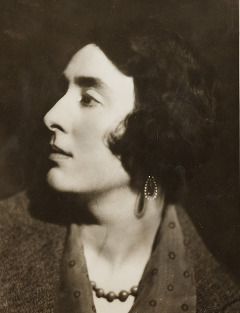
Vita Sackville-West
Vita Sackville-West
Orlando is Virginia Woolf's attempt to turn biography on its head. It's fiction, but is presented as non fiction, even including an index. Orlando's life itself refuses to conform to the template for all standard biographies. His story begins as a sixteen year-old nobleman in the Elizabethan age, and when it ends, she is thirty-six, and the year is 1928 (Woolf's present day). No, that wasn't a typo - Orlando wakes up part way through the book to discover he has become a woman.

Perhaps the only convention that Woolf aims for - and she even achieves that unconventionally - is to evoke the spirit of each age Orlando lives through. She explores the question of  how much we are an individual, and how much we are shaped by the world around us. Only in the Victorian period does Orlando feel out of sync with her life, which she remedies by taking a few minutes to find a husband and embrace the conventionality of the age.

Like Orlando, Woolf and her circle, the Bloomsbury Group, tended to bend and transgress societal boundaries. Although she and her husband had a deep love for one another, her life was coloured by an intense Sapphic affair with Vita Sackville-West, whose family owned the Knole estate in Kent. Orlando, of course, is Vita, not even thinly disguised - several photographs of 'Orlando' included in the book are of Vita.

Orlando is described as Woolf's love letter to Vita Sackville-West. While this is indisputably true, I also read it as a love letter to England. The anchor in Orlando's life is the great oak tree on his estate, whose roots, he feels, are the ribs that help anchor it - and him - to the earth. Although a prevailing theme of the novel is literature, its symbol is Orlando's poem "The Oak Tree", four hundred years in the making. The Spirit of the Age is found not only in the literary lights, but in the very atmosphere of the country, from the bold weather of Elizabeth's reign to the fertile, damp miasma of the Victorian age. Poetry, literature, life, love - Orlando never finds the answers to these questions, that bend and twist with each new century. Only the land remains a constant one can trust.

Admittedly, Woolf is not for the casual reader. But if you are serious about literature, enjoy quirky novels, and a good dose of poetry - or you're an Anglophile or bibliophile - Orlando is worth a read.