Friday, 9 December 2011

Christmas Fare

 Where did the time go?  First Thanksgiving, and then Finals time at the university, and I realize it's been several weeks since I posted.  For the Christmas season, I thought I'd pass on some historical recipes in the next couple of weeks.  First, two treats from the Edwardian era:

MINCEMEAT CAKE
This recipe makes a quick and lighter alternative to traditional Christmas cake. It can be decorated or left as it is

Ingredients:
 4oz butter or margarine
 4oz soft brown sugar
 7oz mincemeat
 2 large free range eggs
 7oz self raising flour
 3 tbsp brandy/sherry
 7in deep round cake tin – lined

Method:
Pre-heat oven to 325F/160°C/gas mark 3. Cream butter and sugar together until light and fluffy. Gradually add eggs, mincemeat and brandy.
Stir in flour until well mixed. Put mixture into lined cake tin and place in oven for 50 to 60 minutes.
Cake is cooked when a skewer inserted into the centre of the cake comes out clean.
Cool completely on a wire rack.
It keeps for up to two weeks in an airtight container.


 CRANBERRY AND ORANGE SPONGE
This can be served as a cold cake at tea time or warm as a pudding with custard

Ingredients:
 8oz butter or margarine
8oz caster sugar
 10oz self raising flour
3 free range eggs
 1 medium orange
1 cup of cranberries (fresh or frozen)
 8in deep round cake tin – lined

Method:
Pre heated oven 350F/180°C/gas mark 4.Cream the sugar and butter together until light and fluffy, then add in the eggs and flour. Finely grate the rind from the orange and squeeze out the juice. Add both the rind and the juice to the cake mixture, stirring well. Now gently fold in the cranberries.
Place the mixture into the lined cake tin and bake fro 40 to 50 minutes.
When cool dust with icing sugar. This cake keeps for two to three days stored in a cool place in an airtight container

Read More http://www.walesonline.co.uk/showbiz-and-lifestyle/food-in-wales/eating-in/2011/11/26/edwardian-christmas-recipes-91466-29835327/#ixzz1g3r8WgaQ

Friday, 18 November 2011

History and Fiction

Thanks to author and critique partner Maggi Andersen for passing on this link: an interview with historical fiction authors Phillipa Gregory and Wayne Johnston on the topic of "truth, lies and historical fiction."  I'll get out of the way and let you enjoy it!

Friday, 4 November 2011

Blog News: English Historical Fiction Authors

Crossdressing women, ghostly chickens, riots in Georgian London, what to wear when you go shooting, feminist writers of the French Revolution: these are just a few of the topics covered thus far on the new blog, English Historical Fiction Authors.  The authors are an unusually eclectic bunch, publishing historical fiction of all genres, and in media from large presses to ebooks.  Men are also very well represented for a change!  And if that's not enough to get you to take a look, they even have a page for posts and short stories by readers.

Their blurb reads: 

Britain leaves us awed by ancient castles, palaces and museums. History pours out a legacy of battles, a developing monarchy, a structured class system, court-inspired behaviors and fashions, artwork and writings that have created an international hoard of Anglophiles. From among them have come forth those who feel that they must fuel the fire. Welcome to the happy home of English Period Authors. We have come together to share our historical work and to reach out to our appreciated readers.

I've added them to my blog list, and I think readers and writers of historical fiction will find them a useful and friendly resource.


Friday, 21 October 2011

The Man Who Outsold Dickens


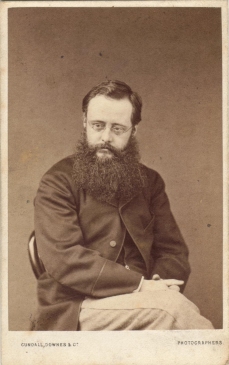
Perhaps it’s a sign of a literary mid-life crisis that I’m finally getting around to reading minor classics that have been on my list for twenty years or so.  That, and the ease of downloading classics to my Nook for a couple of dollars.  Whatever the reason, over the past year I’ve read both The Woman in White and The Moonstone by Wilkie Collins – and I could barely put them down.


What puts Collins on my minor classic list is that, along with other authors I’ve reviewed, he could best be classed as a popular rather than a [classic] author.  Of all the fruits of his his forty-year writing career, only the two above-mentioned books are widely read, and only two others, Armadale and No Name receive much recognition.


Collins was famous – if not infamous – for his time.  He spent most of his life in liaisons with two women (simultaneously); his penchant for the sensational led him and his friend, Charles Dickens, into nights of “dissipation” on the streets of London and in brothels on the continent.  The Moonstone was written under the effects of laudanum, the only drug that offered him relief from several painful conditions that afflicted him for much of his adult life.  Like the physician Ezra Jennings in The Moonstone, this addiction caused him to suffer from terrifying hallucinations.


Collins struck up a friendship with the much older Charles Dickens at the instigation of the latter.  Dickens, it seems, recognized in Collins the creative drive and attraction to the seamier side of Victorian life in himself.  Dickens nurtured Collins’s career, publishing his work in his own magazines and helping him negotiate the publishing business.  The two eventually collaborated on a play, The Frozen Deep, about a woman’s two suitors flung together on an ill-fated trip to the Arctic (a plot which it is said gave Dickens the idea for A Tale of Two Cities).  However, Collins’s enormous financial and literary success rubbed his mentor the wrong way, and when he published The Moonstone, a book that outsold Great Expectations, Dickens testily complained that “the construction was beyond endurance.”


But to the novels themselves.  The Woman in White has a plot that hinges on stolen identity.  It begins with artist Walter Hartright’s mysterious encounter with a ghostly woman in white on Hampstead Heath.  On arriving at his new post in Limmeridge, he finds that his pupil, Laura Fairlie, bears an uncanny resemblance to this woman.  He finds himself falling in love with Laura, but she is pledged to Sir Percival Glyde.  When Walter flees to South America in hopes of forgetting his love, Laura is left in the hands of a husband desperate for money, and who, along with her uncle-in-law, Count Fosco, hatches a terrifying plan to gain her fortune.  Filled with melodrama, a full cast of conventional and unconventional heroes and villains, and captivating parallels in plot and character, The Woman in White delivers page after page.  And I have to add that Count Fosco is one of the most repulsive and fascinating villains I have ever come across in literature.


The Moonstone concerns the theft of the fabulous diamond of the book’s title.  Originally stolen from the forehead of a statue of an Indian moon-god, the stone arrives, along with a supposed curse, to England, only to be stolen again on the very night it is bequeathed to Rachel Verinder on her eighteenth birthday.  The list of suspects is long, the plot deftly twisted without ever quite being tied in a knot – and the truth had me guessing until the end of the novel.  The Moonstone is also notable for perhaps the first developed detective character in a British novel: the sharp-witted, rose-loving Sergeant Cuff.

Both novels are narrated in a manner that resembles a dossier on a crime, with each of several characters giving their story, or evidence.  With no single, controlling narrative voice to assure the reader of meaning, and no assurance that we are reading the truth from any one character, we are dragged along in fascinated compulsion to the end.


Like Collins himself, most of his works have been buried without ceremony.  Yet The Woman in White and the Moonstone remain as a fitting monument for the little man who caused such a big sensation in the Victorian literary world.

Friday, 30 September 2011

A Scottish Duo: new releases

A couple of new Scottish releases from authors I'm acquainted with.  First, Anita Davison, whose novel, Culloden Spirit, is published by Muse It Up.  Here's an edited blurb from her book - for more information, check out Anita's blog.

When Carrie's family takes a summer trip to her father’s ancestral home in the Scottish Highlands, her handsome Scottish cousin, Duncan McRae, takes an immediate dislike to Carrie, mainly due to her father’s plans to refurbish Cair Innes castle which is in need of extensive repair beyond the means of its present owner and resident, Iain McRae.

Carrie feels the vacation will be a disaster until she discovers a strange young man while exploring the derelict castle, However, she soon learns Ruairi McRae is not what he seems, and the battle he intends to fight was lost by his clan a hundred and fifty years before.

Will Carrie be able to accept that she cannot be part of Ruairi’s world? And when the Roma arrive to camp on Bucks Meadow as they do every summer, who is the beautiful gypsy girl Duncan won't talk about?

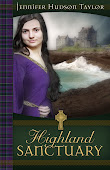
Also out this month is Jennifer Hudson Taylor's Highland Sanctuary, the second (but not sequel!) in her Highland series.  The first, Highland Blessings, was a find summer read for me last year.  If you like inspirational historical fiction, you should check out the goodies for offer in Jennifer's book launch contest, running on her blog until October 9th.  Her book blurb:
Gavin MacKenzie, a chieftain heir who is hired to restore the ancient Castle of Braigh, discovers a hidden village of outcasts who have created their own private sanctuary from the world. Among them is Serena Boyd, a mysterious and
comely lass, who captures Gavin’s heart in spite of harboring a deadly past that could destroy her future.

The villagers happen to be keeping an intriguing secret as well. When a fierce enemy launches an attack against them, greed leads to bitter betrayal. As Gavin prepares a defense, the villagers unite in a bold act of faith...

(P.S. I'm experimenting with a font that doesn't need to be huge print to read well on blogger, so bear with me!)


Friday, 23 September 2011

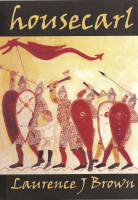
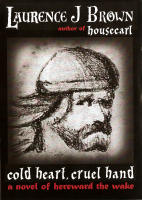
Housecarl and Cold Heart, Cruel Hand by Laurence J. Brown


Laurence Brown was the first author to introduce me to the fact that there are writers out there producing quality work – and doing it pretty successfully – without the backing of either an agent or a traditional publisher.  He’s also a gracious person who is always willing to share his experiences and advice with other writers.

His two novels follow the story of the Saxon warrior Ranulf, a member of King Harold Godwineson’s personal guard.  The first, Housecarl, follows the events of 1066, where the course of European history is changed in one month and three battles on English soil; Cold Heart, Cruel Hand traces the aftermath of the Battle of Hastings and Ranulf’s decision to join the rebellion of Hereward the Wake in a last bid for freedom for the Saxon people.  Laurence has a knack for bringing battles to life and recreating the real, human relationships of those who are barely even a footnote in English history.

Laurence drew inspiration from several sources, in particular, his father, who imparted a love of history, and an enthusiastic junior school teacher.  He recalls, “I remember our history teacher telling us about 1066 and the Norman invasion of England and showing us an extract from the Bayeux Tapestry depicting Harold's warriors lining the hill with their shields overlapping, their hedge of spears pointed menacingly at the Norman cavalry. I asked the teacher who they were and he said: ‘Those were Harold's housecarls, Laurence, the bravest warriors in Christendom.’”

I was pleased to catch up with Laurence and discover he is writing a third novel in the series, in fact a prequel, in which Ranulf, now an old man, recounts the story of how he came to be Harold’s champion.  “It is something of a departure of style for me since Ranulf is narrating the tale himself,” he comments.  “In a sense his voice is mine, his thoughts, his character, is mine and it is both exciting and a little worrying - I don’t want to spoil the image that readers already have of him.”

Laurence’s books were first published by Paul Mould Publishing (Empire Books in the US), and are now also available as Kindle editions.  For more information, please visit his website.

Friday, 9 September 2011

Historical Fiction News

Some interesting news from the latest issue of The Historical Novels Review, a publication of the Historical Novel Society.  After a successful fifteen years of conferences, an excellent quarterly review of all new UK and US historical fiction, and a lively magazine, Solander, they are gearing up to become a web-based society.


Among changes touted by the society's founder, Richard Lee, will be daily updates of news and book reviews, facebook links and twitter feeds, and, eventually, a searchable database of all reviews.  Check out the current website for a taste of what is already on offer, including the online review that covers ebooks, non-conventional presses and self-published novels.

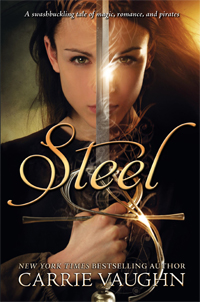
The two covers in this post are of the latest books I and my daughter reviewed for the society.  Click on the images to learn more.

Carrie Vaughn's Steel


Amit Mujmadar's Partitions